
And the trust I carry did not begin with me. CAN was born in 2001 in Uganda, when practitioners from several African countries came together and recognized a simple truth: they were working in isolation, and the knowledge accumulating in each country never reached the country next door. So they decided to build a bridge. From that decision came the world's first continental network for community based rehabilitation a network that later inspired its counterparts in Asia, Latin America, and the Pacific, and that helped found the CBR Global Network in 2012. To lead an institution with this history is to understand, every morning, that you are one link in a chain neither its beginning nor its end.
Leading a network is alignment, not command
I spent years managing organizations before taking on this role, and I assumed the skill was the same. I learned quickly that leading a network is fundamentally different from running an organization. In an organization, you issue a decision and follow its execution. In a network, you hold no authority to command; you hold only your ability to build consensus. My daily work at CAN is not giving orders it is alignment: across five African regions, each with its own reality; across many languages Arabic, English, French, Portuguese, Swahili; and across nearly three thousand members carrying countless field experiences. A network's real strength is never at its centre; it lives in the connections between its parts.
A chair's job is to strengthen those connections, not to replace them with himself.
When I received the leadership from my colleague Therese Adjay in March 2025, I set myself a single question: what will make this network stronger a year from now? The answer was not one brilliant project, but quiet, cumulative building. We supported forming and reactivating national networks in Niger, South Sudan, Kenya, Cameroon, and Egypt, because a continental network is only complete when national networks carry it. When we launched our online training series on network formation, we began with 46 participants and soon passed 125 including people from outside Africa, from Trinidad and Tobago, Nevis, and St. Kitts. And in the background, we did the work that never appears in photographs: a new International Advisory Board, accountability and follow-up systems, a framework for selecting Country Representatives after years of dormancy, and a partnership with Liliane Fonds to build virtual Centres of Excellence that document and share Africa's best practices.
To lead is to learn
But the most important lesson this role has taught me is not about management; it is about listening. After more than two decades in this field, I remain convinced that the most important quality in the leader of a continental network is not to teach, but to learn. From villages in Upper Egypt to halls in Geneva, from a community nurse in Niger to a researcher at a Kenyan university each holds a lesson worth hearing. My task is to be the network's greatest learner: to move knowledge from where it exists to where it is needed. This leads me to a principle that governs every decision we make: "Nothing about us without us." Persons with disabilities at CAN are not recipients of services; they are leaders and partners in decision-making, which is why we ensure that young people with disabilities have a voice on our board, in our networks, and at our coming Congress.
And here lies what I consider the most important milestone ahead of us: the 3rd World Congress on Community Based Rehabilitation and Community Based Inclusive Development, to be held in Egypt in 2027. For Africa to host this international gathering means the continent moves from the margins of the conversation to its centre: we receive the world on our own ground, on our own terms, in our own voice. Reaching this moment was not a single decision, but a long chain of follow up, patience, and persuasion. The hardest doors to open are often the most worth walking through.
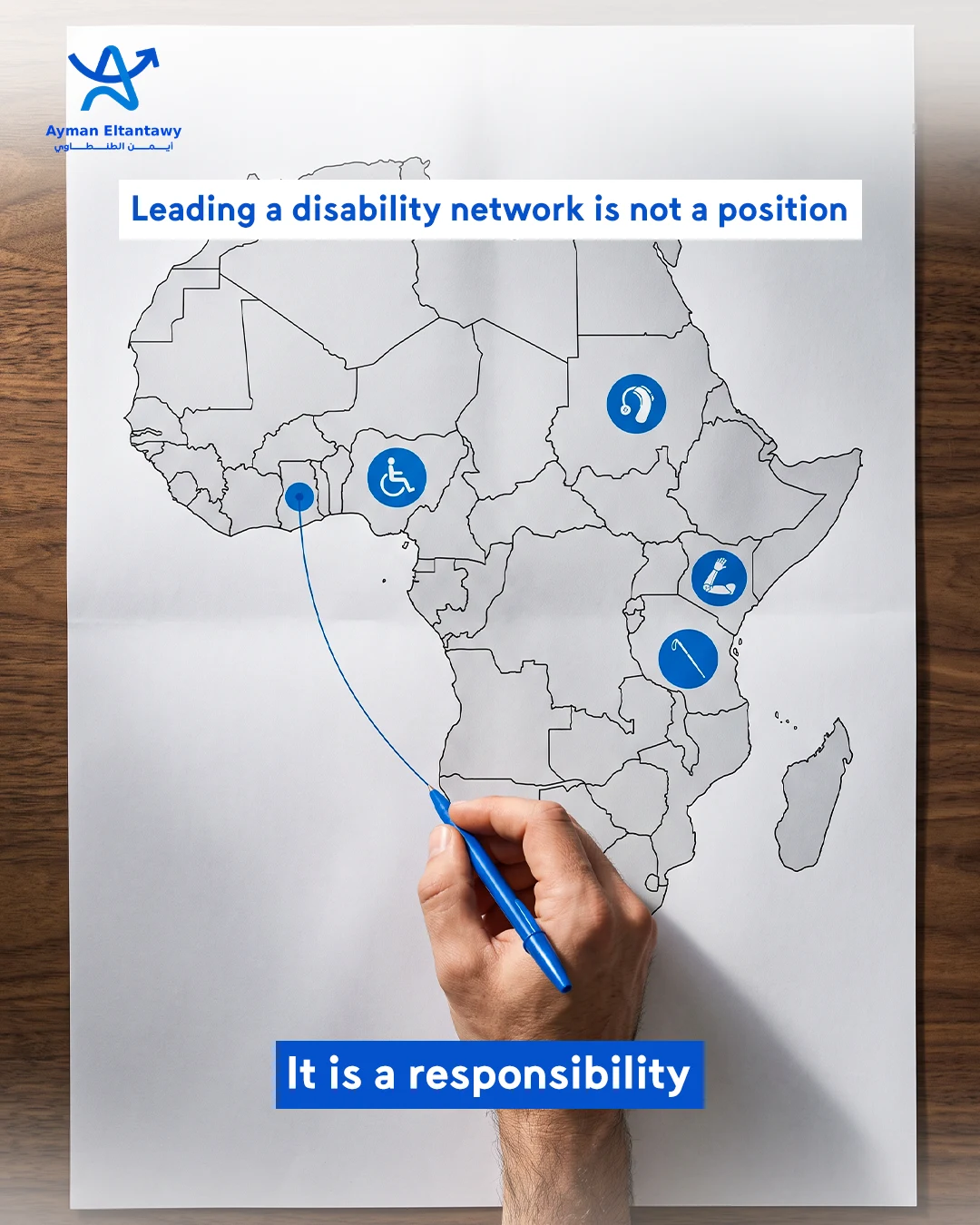
If you ask me today what it means to lead the CBR Africa Network, I will not speak of a title or a position. I will say it is the honour of carrying, for a while, a legacy larger than yourself and handing it on stronger than you received it. The most successful leaders, in the end, make themselves unnecessary. And the question I leave for anyone leading an institution in our field: are we building people who need us, or systems and knowledge that outlast us?
Comments (0)